

 SEARCH

SEO Tech Audit Service: Expert Guide

December 1st, 2025
posted by Radomir Basta to seo audit service, seo audit services, seo audits, seo tech audit service, technical site auditWhy Most Technical SEO Audits Fail to Move the Needle
Your traffic is declining. A migration is weeks away. The stakes are high, and the clock is ticking. You commission a technical SEO audit, expecting a roadmap to recovery. Instead, you receive a 200-page PDF filled with generic findings and no clear path to implementation.
The gap between audit findings and shipped fixes is where rankings die. Most SEO audit services stop at documentation. They deliver checklists without specifications. Reports without tickets. Recommendations without ownership.
This creates four critical problems:
- Development teams receive vague directives instead of actionable specifications
- Prioritization becomes guesswork without business impact quantification
- Post-launch monitoring is nonexistent, leaving you blind to regression
- Implementation timelines stretch from weeks to months as teams debate scope
An SEO tech audit service should bridge this gap. It should deliver ticket-ready specifications, coordinate with engineering sprints, and monitor performance daily after launch. That’s the standard we built over 12 years of enterprise technical SEO work.
What Separates Engineering-Driven Audits from Generic Checklists
The difference between a checklist and an engineering-driven audit comes down to implementation precision. Generic audits identify problems. Strategic audits solve them.
The Standard Audit Approach
Most SEO audits follow a predictable pattern. They crawl your site, run automated tests, and compile findings into a report. The deliverable looks comprehensive but lacks execution detail.
Standard audits typically include:
- Automated crawl data with error lists
- Generic recommendations copied across clients
- No prioritization framework tied to business impact
- Zero coordination with development workflows
- One-time delivery with no follow-up monitoring
Your development team receives this report and faces immediate questions. Which issues matter most? What are the exact specifications? How do we test these changes? Who owns acceptance criteria?
The Engineering-First Methodology
An engineering-driven approach starts with implementation in mind. Every finding includes the specification your developers need to ship the fix. Every recommendation maps to business impact. Every change includes testing protocols and rollback plans.
This methodology delivers:
- Ticket-ready specifications with acceptance criteria
- Prioritization matrices linking fixes to revenue impact
- Direct coordination with sprint planning and QA cycles
- Daily performance monitoring with automated alerting
- Architectural analysis beyond surface-level checks
The outcome changes completely. Instead of a static document, you receive an operational framework. Instead of generic advice, you get precise specifications. Instead of one-time delivery, you gain continuous optimization.
Core Components of a Strategic Technical SEO Audit
A comprehensive technical site audit examines seven critical systems. Each system requires depth beyond automated scanning. Each demands architectural understanding.
Crawl Budget and Indexation Management
Search engines allocate finite resources to crawling your site. Waste that budget on low-value pages, and your important content gets ignored. Log file analysis reveals exactly where crawl budget goes and why.
This analysis uncovers:
- Crawl traps consuming resources on infinite pagination or faceted navigation
- Orphaned pages receiving no internal links or crawl attention
- Redirect chains and loops forcing multiple requests per page
- Server errors blocking access to critical sections
- Robots.txt misconfigurations preventing indexation of valuable content
The fix goes beyond identifying problems. It requires architectural remediation – restructuring how pages link, implementing strategic canonicalization, and optimizing XML sitemaps to guide crawlers efficiently.
Information Architecture and Content Hierarchy
Poor information architecture creates keyword cannibalization. Multiple pages compete for the same query, diluting authority and confusing search engines about which page to rank.
An information architecture audit maps your content hierarchy and identifies conflicts. This includes analyzing URL structures, internal linking patterns, and topical clustering. The goal is singular: ensure each target keyword has one authoritative landing page supported by strategic internal links.
Remediation often requires:
- Consolidating duplicate or overlapping content into authoritative hubs
- Implementing 301 redirects with preserved link equity flow
- Restructuring internal linking to reinforce topical authority
- Creating clear parent-child relationships in URL architecture
Core Web Vitals and Performance Optimization
Page experience metrics directly impact rankings. A core web vitals audit measures loading performance, interactivity, and visual stability across your site. The 2024 shift to Interaction to Next Paint (INP) makes this even more critical.
Performance analysis examines:
- Largest Contentful Paint (LCP) – measuring main content render speed
- Interaction to Next Paint (INP) – quantifying page responsiveness
- Cumulative Layout Shift (CLS) – tracking visual stability during load
- JavaScript hydration delays on client-side rendered frameworks
- CDN configuration and edge caching effectiveness
Fixes require coordination with engineering. You need specific recommendations on code splitting, lazy loading implementation, and server-side rendering optimization. Generic advice to “improve performance” wastes sprint cycles.
JavaScript Rendering and Modern Framework Challenges
Client-side JavaScript frameworks create unique crawling challenges. Search engines must render JavaScript to access content, consuming additional resources and creating indexation delays.
Modern sites require analysis of:
- Server-side rendering (SSR) vs client-side rendering (CSR) implementation
- Hydration timing and its impact on interactivity metrics
- Dynamic content accessibility to search engine crawlers
- Rendering budget consumption across page types
Solutions depend on your tech stack. Next.js sites need different optimization than Angular applications. React implementations require specific rendering strategies. Cookie-cutter recommendations fail here.
Schema and Structured Data Implementation
Structured data helps search engines understand your content and enables rich result features. A schema audit verifies correct implementation and identifies opportunities for enhanced visibility.
This includes reviewing:
- Organization and LocalBusiness schema for brand entity recognition
- Product and Offer markup for e-commerce visibility
- Article and NewsArticle schema for content discoverability
- FAQ and HowTo markup for featured snippet eligibility
- BreadcrumbList schema for navigation clarity
Implementation requires precise JSON-LD formatting and validation against Google’s guidelines. Errors in structured data can trigger manual actions or feature removal.
International and Multi-Regional Configuration
Sites serving multiple countries or languages face complex technical requirements. Hreflang implementation, URL structure decisions, and content duplication management become critical.
Multi-regional audits examine:
- Hreflang tag accuracy and reciprocal linking between language versions
- URL structure choices (subdirectories vs subdomains vs ccTLDs)
- Content duplication handling across regional variations
- Geotargeting settings in Search Console
- CDN configuration for regional content delivery
Migration Planning and Risk Mitigation
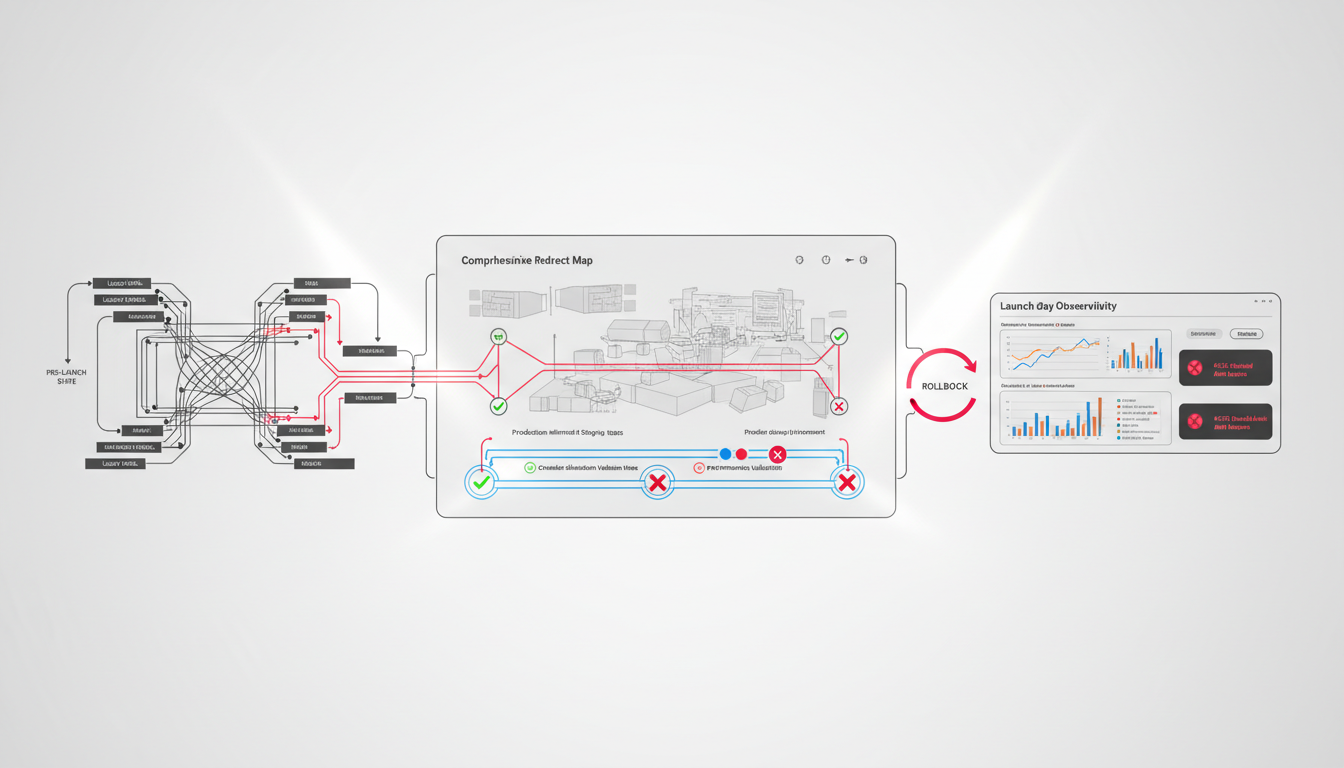
Website migrations carry enormous risk. Platform changes, domain moves, and URL restructuring can destroy years of SEO equity overnight. A migration SEO audit establishes protocols to prevent catastrophic losses.
Migration oversight includes:
- Pre-migration baseline documentation of all rankings and traffic
- Comprehensive redirect mapping with link equity preservation
- Staging environment testing and crawler simulation
- Launch day monitoring with rollback criteria clearly defined
- Post-migration validation and issue remediation
The difference between successful and failed migrations is preparation detail. You need explicit rollback plans, not reassurances.
The Three-Phase Implementation Framework
Audit findings mean nothing without execution. This framework transforms analysis into shipped fixes through three distinct phases, each with clear deliverables and ownership.
Phase One: Deep Analysis and Architectural Assessment
The first phase establishes baseline performance and identifies all technical barriers to organic visibility. This goes beyond automated crawling to include forensic analysis of server logs, rendering behavior, and indexation patterns.
Deliverables include:
- Comprehensive crawl report with categorized issues and severity ratings
- Log file analysis revealing actual search engine behavior on your site
- Performance benchmarking across device types and connection speeds
- Information architecture mapping with cannibalization identification
- Competitive gap analysis showing where competitors gain advantage
Each finding includes business impact quantification. You see exactly how fixing each issue affects traffic, rankings, and revenue. This enables data-driven prioritization.
Phase Two: Strategic Execution and Implementation Coordination
The second phase translates findings into shipped code. This requires direct coordination with your development team, sprint planning integration, and continuous testing throughout implementation.
Implementation coordination delivers:
- JIRA tickets with complete specifications and acceptance criteria
- Prioritization matrix ranking fixes by impact and implementation effort
- Sprint planning sessions to scope work and allocate resources
- QA protocols with specific test cases for each change
- UAT scripts ensuring changes work as specified before production
- Rollback plans with clear triggers and restoration procedures
Your developers receive exactly what they need to ship fixes confidently. No ambiguity. No interpretation required. Just precise specifications and clear success criteria. To discuss how this coordination model fits your development workflow, request a strategic audit tailored to your technical environment.
Phase Three: Continuous Optimization and Performance Monitoring
The third phase protects your investment through daily monitoring and rapid response to issues. Technical SEO is not a one-time project. Sites evolve. Code changes. New issues emerge.
Continuous optimization includes:
- Daily performance monitoring with automated alerting on threshold breaches
- Weekly ranking and traffic analysis to catch issues before they compound
- Monthly strategic reviews identifying new optimization opportunities
- Incident response protocols for rapid issue remediation
- Ongoing coordination with development cycles as the site evolves
This monitoring catches problems immediately. A sudden indexation drop triggers an alert. A performance regression gets flagged before it impacts rankings. You maintain visibility into site health continuously.
Implementation Toolkit: From Findings to Shipped Fixes
The gap between audit recommendations and production code is where most initiatives stall. This toolkit eliminates that gap with templates, examples, and frameworks your team can use immediately.
Prioritization Matrix and Impact Quantification
Not all technical issues carry equal weight. Some fixes deliver immediate ranking improvements. Others provide marginal gains. The prioritization matrix ranks every finding by business impact and implementation effort.
The matrix evaluates:
- Traffic impact – potential ranking improvements and click-through rate gains
- Revenue impact – conversion rate effects and transaction value changes
- Implementation effort – development time and technical complexity
- Risk level – potential for unintended consequences or rollback needs
This creates a clear roadmap. High-impact, low-effort fixes ship first. Complex architectural changes get properly scoped and resourced. Nothing sits in backlog limbo without clear justification.
Sample JIRA Tickets with Acceptance Criteria
Vague tickets create implementation delays. Developers waste cycles clarifying requirements. QA struggles to validate changes. Precise specifications eliminate this friction.
Each ticket includes:
- Clear problem statement with business impact quantification
- Specific technical requirements and implementation approach
- Acceptance criteria defining what “done” looks like
- Test cases for QA validation before production deployment
- Rollback procedure if issues emerge post-launch
Your development team receives tickets they can estimate accurately and ship confidently. No ambiguity. No interpretation gaps. Just clear specifications.
QA and UAT Checklists for Pre-Launch Validation
Changes that pass development testing sometimes fail in production. Edge cases emerge. Browser-specific issues surface. UAT protocols catch these problems before users and search engines encounter them.
Pre-launch validation includes:
- Crawl simulation testing to verify search engine accessibility
- Performance benchmarking across device types and connection speeds
- Cross-browser rendering validation for JavaScript-heavy implementations
- Mobile usability testing on actual devices, not just emulators
- Structured data validation through Google’s Rich Results Test
Monitoring Dashboards and Alerting Thresholds
Daily monitoring protects your technical foundation. Automated alerts catch issues immediately. You know about problems before they compound into traffic losses.
Monitoring tracks:
- Indexation levels – pages indexed vs pages submitted in sitemaps
- Crawl errors – 4xx and 5xx response codes blocking access
- Performance metrics – Core Web Vitals across page types
- Ranking positions – daily tracking of target keywords
- Traffic patterns – anomaly detection for sudden drops
Threshold breaches trigger immediate alerts. A 10% indexation drop sends a notification. A performance regression gets flagged. You respond to issues in hours, not weeks.
RACI Model for Implementation Ownership
Unclear ownership creates implementation bottlenecks. The RACI model defines who is Responsible, Accountable, Consulted, and Informed for each task. This eliminates confusion and accelerates execution.
For technical SEO implementations:
- Responsible – Development team executes the technical changes
- Accountable – Technical SEO lead owns outcomes and success metrics
- Consulted – Product and UX teams provide input on user impact
- Informed – Marketing and executive stakeholders receive progress updates
Clear ownership means faster decisions and eliminated bottlenecks. Everyone knows their role. Nothing waits for clarification.
Why Enterprise Sites Need Specialized Audit Approaches
Enterprise websites face technical challenges that generic audits miss. Scale introduces complexity. Multiple teams create coordination challenges. Legacy systems constrain implementation options.
Our technical SEO audit services are designed for enterprise technical SEO audit requirements.
Traffic Recovery for Algorithmic Penalties
Sudden traffic drops require immediate forensic analysis. A traffic recovery SEO audit identifies the root cause and maps the recovery path. Time matters – delayed response compounds losses.
Recovery audits examine:
- Algorithmic update timing correlation with traffic decline
- Quality signals that may have triggered ranking suppression
- Technical issues that coincided with the drop
- Competitive changes that shifted SERP landscape
- Historical performance patterns revealing seasonal factors
The analysis pinpoints exactly what changed and why. Recovery plans include specific fixes ranked by impact speed. You see the path back to previous performance levels.
Content Architecture for Large-Scale Sites
Sites with thousands of pages face unique information architecture challenges. Content organization affects crawl efficiency, internal linking effectiveness, and topical authority signals.
Large-scale architecture audits address:
- Taxonomy design that balances user navigation with SEO requirements
- URL structure that scales without creating depth problems
- Internal linking automation that maintains relevance at scale
- Canonicalization strategies for product variations and filters
- Pagination implementation that preserves crawl efficiency
Solutions must account for CMS limitations and publishing workflows. Recommendations that ignore operational constraints never ship.
Migration Oversight for Platform Changes
Platform migrations carry catastrophic risk at enterprise scale. Thousands of URLs change. Redirect mapping becomes complex. Testing requirements multiply. A migration SEO audit provides the framework to execute safely.
Migration planning includes:
- Pre-migration documentation of all rankings, traffic, and conversions
- Comprehensive URL mapping with redirect chain elimination
- Staging environment setup mirroring production configuration
- Phased rollout plan with validation gates between phases
- Launch day monitoring with explicit rollback criteria
- Post-migration validation ensuring all redirects function correctly
The difference between successful and failed migrations is preparation detail. You need documented protocols, not reassurances.
2025 Technical SEO Considerations
Search engine behavior evolves constantly. Audit methodologies must incorporate recent changes to remain effective. Several 2025 updates demand attention.
Watch this video about seo tech audit service:
Interaction to Next Paint (INP) Replacing FID
Google replaced First Input Delay with Interaction to Next Paint as a Core Web Vitals metric in March 2024. INP measures total interactivity, not just initial response. This changes optimization priorities.
INP optimization requires:
- Reducing JavaScript execution time during user interactions
- Minimizing main thread blocking from third-party scripts
- Optimizing event handler performance across the page lifecycle
- Testing interactions beyond initial page load
Sites that optimized for FID may fail INP thresholds. Comprehensive testing across user journeys becomes essential.
AI Overviews Impact on Search Visibility
AI-generated search results change how users interact with SERPs. Traditional ranking positions matter less when AI summaries answer queries directly. This affects content strategy and technical implementation.
Optimization for AI Overviews includes:
- Structured data implementation that helps AI understand content context
- Clear, concise content formatting that facilitates extraction
- Authoritative signals that increase citation likelihood
- FAQ schema that provides direct answer formats
Index Management and Crawl Budget Optimization
Google’s evolving approach to indexation makes crawl budget management more critical. The IndexIfEmbedded robots directive and refined crawling algorithms change optimization strategies.
Modern index management focuses on:
- Strategic use of robots meta tags to guide indexation decisions
- XML sitemap optimization highlighting priority content
- Internal linking that reinforces content importance signals
- Crawl trap elimination to preserve bot resources
JavaScript Framework Rendering Challenges
Modern JavaScript frameworks introduce rendering complexity. Server-side rendering, static site generation, and hybrid approaches each carry distinct SEO implications.
Framework-specific optimization addresses:
- Next.js incremental static regeneration for dynamic content
- React hydration timing and its impact on interactivity metrics
- Vue.js server-side rendering configuration
- Angular Universal implementation for search engine accessibility
Generic JavaScript recommendations fail here. Framework-specific expertise becomes essential.
How to Evaluate Technical SEO Audit Providers
Not all SEO audit services deliver equal value. Provider selection determines whether you receive actionable specifications or generic recommendations. These evaluation criteria separate strategic partners from report factories.
Implementation Coordination Capability
Ask providers how they coordinate with development teams. Do they deliver JIRA tickets with specifications? Do they participate in sprint planning? Do they provide QA protocols?
Strong providers offer:
- Direct coordination with your development team throughout implementation
- Ticket-ready specifications with acceptance criteria
- Sprint planning participation to scope work accurately
- QA and UAT support before production deployment
Weak providers deliver reports and disappear. The implementation gap remains unbridged.
Post-Audit Monitoring and Support
Technical SEO requires ongoing attention. Sites evolve. Issues emerge. Ask providers about post-audit support and monitoring.
Comprehensive providers include:
- Daily performance monitoring with automated alerting
- Regular strategic reviews identifying new opportunities
- Incident response for rapid issue remediation
- Continuous coordination as your site evolves
Limited providers deliver one-time audits with no follow-up. You’re on your own after delivery.
Architectural Analysis Depth
Surface-level audits miss systemic issues. Ask providers about their architectural analysis approach. Do they examine information architecture? Do they analyze crawl patterns through log files? Do they assess rendering behavior?
Deep analysis includes:
- Log file analysis revealing actual search engine behavior
- Information architecture mapping with cannibalization identification
- Rendering analysis for JavaScript framework implementations
- Crawl budget optimization based on actual bot behavior
Team Expertise and Retention
Technical SEO expertise develops over years. Ask about team composition and tenure. How long have team members worked together? What’s their background?
Experienced teams demonstrate:
- Long-term team member retention indicating knowledge preservation
- Diverse technical backgrounds spanning development and SEO
- Track record across multiple industries and technical stacks
- Proprietary tool development showing deep technical capability
High turnover teams lose institutional knowledge. Junior practitioners lack pattern recognition from years of implementations.
Deliverable Clarity and Actionability
Review sample deliverables before engaging. Do they include clear specifications? Are recommendations prioritized by impact? Is ownership defined?
Strong deliverables contain:
- Prioritization matrices ranking fixes by business impact
- Technical specifications with implementation details
- Clear ownership assignment using RACI or similar models
- Success metrics and validation criteria
Weak deliverables list problems without solutions. Generic recommendations apply to any site. No prioritization guidance helps you sequence work. For a detailed comparison of audit approaches and what to expect from each phase, see all technical SEO insights covering methodology, implementation, and results.
Real-World Implementation: What Success Looks Like
Abstract methodology means little without concrete outcomes. Two anonymized examples illustrate how engineering-driven audits translate to measurable results.
Enterprise E-Commerce Traffic Recovery
A large e-commerce site experienced a 40% traffic decline following a platform migration. Initial analysis revealed multiple technical issues compounding simultaneously.
The audit identified:
- Redirect chains averaging 4 hops causing crawl budget waste
- JavaScript rendering delays preventing product indexation
- Duplicate content across product variations confusing search engines
- Missing structured data eliminating rich result eligibility
Implementation took 8 weeks across three sprints. Traffic recovered to 95% of pre-migration levels within 12 weeks. Conversion rate improved 15% due to performance optimizations included in the remediation.
SaaS Platform Architecture Remediation
A B2B SaaS platform struggled with keyword cannibalization across 200+ feature pages. Multiple pages competed for the same queries, diluting authority and suppressing rankings.
The information architecture audit revealed:
- 17 distinct pages targeting identical keyword sets
- Internal linking patterns reinforcing the cannibalization
- URL structure creating unnecessary hierarchy depth
- Missing canonical tags allowing duplicate indexation
Remediation consolidated content into authoritative hubs supported by strategic internal linking. Organic traffic increased 65% over 6 months. Target keyword rankings improved an average of 12 positions.
The Technical Audit Service Delivery Model
Service delivery determines whether audits translate to results. This model ensures findings become shipped fixes through clear processes and defined ownership.
Initial Discovery and Scoping
Every engagement begins with discovery. This phase establishes baseline performance, identifies priority challenges, and scopes the audit approach.
Discovery includes:
- Stakeholder interviews with SEO, product, and engineering leads
- Historical performance analysis revealing traffic patterns
- Technical stack assessment determining implementation constraints
- Priority challenge identification focusing audit scope
- Timeline and resource planning for implementation phases
This scoping ensures the audit addresses your specific challenges. Generic approaches waste time on irrelevant analysis.
Comprehensive Analysis and Documentation
The analysis phase examines all technical systems affecting organic visibility. This goes beyond automated crawling to include forensic analysis and architectural assessment.
Analysis deliverables include:
- Comprehensive findings document with categorized issues
- Prioritization matrix ranking fixes by business impact
- Technical specifications for each recommended change
- Competitive analysis showing where gaps exist
- Implementation roadmap sequencing work across sprints
Implementation Coordination and Execution Support
The coordination phase translates findings into shipped code. This requires direct engagement with your development team throughout the implementation cycle.
Coordination includes:
- Sprint planning sessions to scope work and allocate resources
- JIRA ticket creation with complete specifications
- QA protocol development with specific test cases
- UAT support ensuring changes work before production
- Launch coordination with monitoring and rollback plans
Your team receives exactly what they need to ship fixes confidently. No interpretation required. Just clear specifications and success criteria. To discuss how this coordination model fits your development workflow, Request Strategic Audit →
Post-Launch Monitoring and Optimization
The monitoring phase protects your investment through continuous performance tracking and rapid issue response. Technical SEO is not a one-time project.
Ongoing monitoring includes:
- Daily performance tracking with automated alerting
- Weekly analysis identifying trends and emerging issues
- Monthly strategic reviews uncovering new opportunities
- Incident response protocols for rapid remediation
Frequently Asked Questions
How long does a comprehensive technical audit take?
Timeline depends on site complexity and scope. A standard enterprise audit takes 2-3 weeks for analysis and documentation. Implementation typically spans 6-12 weeks across multiple development sprints. Sites with complex architectures or migrations may require extended timelines.
What access do auditors need to my site and systems?
Comprehensive audits require read access to Google Search Console, Google Analytics, server logs, and your CMS. Development environment access helps validate fixes before production. The exact requirements vary based on your technical stack and audit scope.
How do you prioritize which issues to fix first?
Prioritization uses a matrix evaluating business impact, implementation effort, and risk level. High-impact, low-effort fixes ship first. Complex architectural changes get properly scoped. The matrix provides clear rationale for sequencing decisions.
What happens if issues emerge after implementation?
Daily monitoring catches problems immediately. Automated alerts notify you of threshold breaches. Incident response protocols enable rapid remediation. Rollback plans ensure you can restore previous configurations if needed. Post-launch support continues until performance stabilizes.
How do you handle audits for sites using modern JavaScript frameworks?
Framework-specific expertise is essential. Audits examine server-side rendering configuration, hydration timing, and rendering budget consumption. Recommendations account for framework constraints and optimization patterns. Generic JavaScript advice fails here.
Can you coordinate with our existing development team?
Direct coordination with your development team is standard practice. This includes sprint planning participation, JIRA ticket creation, QA protocol development, and UAT support. The goal is seamless integration with your existing workflows.
What makes your approach different from automated audit tools?
Automated tools identify surface-level issues. Strategic audits provide architectural analysis, business impact quantification, and implementation coordination. You receive ticket-ready specifications, not generic checklists. Post-launch monitoring protects your investment continuously.
How do you measure audit success?
Success metrics align with your business goals. Common measures include organic traffic growth, ranking improvements for target keywords, indexation rate increases, and Core Web Vitals score improvements. Revenue impact quantification ties technical fixes to business outcomes.
Moving from Analysis to Action
Technical SEO audits fail when they remain documents instead of becoming operational frameworks. The gap between findings and fixes determines whether you gain competitive advantage or waste resources.
An engineering-driven approach eliminates this gap through three critical elements:
- Ticket-ready specifications that enable confident implementation
- Direct coordination with development teams throughout execution
- Daily monitoring that protects your investment continuously
You leave with a hardened technical foundation and a clear operating model. Not a static report collecting dust. Not generic recommendations requiring interpretation. A complete framework for maintaining organic visibility as your site evolves.
The difference between strategic and generic audits compounds over time. Strategic audits become operational systems. Generic audits become forgotten documents. Your choice determines whether technical SEO becomes a competitive advantage or a recurring cost center.
Ready to see how this methodology applies to your specific technical challenges? Review the detailed service scope, sample deliverables, and implementation frameworks on our complete technical SEO audit service guide page.