

 SEARCH

Affordable SEO Audit Services Dubai

December 29th, 2025
posted by Radomir Basta to affordable seo audit services dubai, seo content audit service, seo tech audit service, site audit pricing dubai, technical seo auditing servicesFor managers and founders in Dubai, affordable SEO audits don’t mean cheaper checklists. They mean faster time-to-fix and measurable results. Most technical audits produce 60-page PDFs that collect dust while rankings continue to slide.
Your development team needs sprint-ready tickets, not generic recommendations. Stakeholders need clear timelines and accountability. The right audit delivers both at a price that makes sense for your business.
This guide shows what an implementation-first SEO audit in Dubai includes, how pricing works across different complexity levels, and how to evaluate providers based on outcomes rather than page counts.
What Makes an SEO Audit Affordable Without Sacrificing Results
Price and value operate on different axes. A $2,000 audit that sits unimplemented costs more than a $15,000 audit that ships fixes within 30 days and recovers lost traffic.
Affordable means your investment produces measurable improvements. It means clear priorities, technical specifications your developers can execute, and coordination that bridges the gap between diagnosis and deployment.
Four Audit Types and Their Cost Drivers
Different business situations require different audit approaches. Each type addresses specific technical challenges and carries distinct cost implications.
- Technical foundation audits – Crawlability, indexation, site architecture, and rendering issues for sites under 10,000 pages
- Content optimization audits – Keyword mapping, content gaps, internal linking architecture, and topical authority assessment
- Migration audits – Pre-launch validation, redirect mapping, and post-migration monitoring for platform changes or redesigns
- Recovery audits – Traffic decline investigation, penalty assessment, and algorithmic update impact analysis
Cost scales with site complexity, not just page count. A 5,000-page JavaScript-heavy e-commerce site with Arabic and English versions requires more analysis than a 20,000-page static blog.
Where Audit Costs Hide in Dubai Markets
Three technical factors drive audit pricing in UAE markets. Understanding these helps you compare proposals accurately and avoid scope creep.
JavaScript rendering complexity adds 30-40% to audit time. Sites built on React, Vue, or Next.js require specialized crawling tools and server-side rendering analysis. Your auditor needs to verify what search engines actually see versus what browsers render.
Multilingual architecture for Arabic and English content demands hreflang validation, language-specific crawl budget analysis, and regional search behavior mapping. Incorrect implementation blocks your content from reaching the right markets.
Core Web Vitals optimization requires performance profiling across device types, CDN configuration review, and resource loading analysis. Dubai’s mix of mobile-first users and desktop enterprise traffic creates unique optimization challenges.
Deliverables That Reduce Implementation Cost
The audit document matters less than what happens after delivery. Implementation-ready specifications cut your time-to-fix by 60-70% compared to generic recommendations.
Your development team needs acceptance criteria, priority rankings, and effort estimates. Marketing needs to understand business impact and resource requirements. Executives need clear ROI projections and risk assessments.
Sprint-Ready Technical Specifications
Generic advice like “improve page speed” wastes developer time. Actionable specifications include exact code changes, configuration updates, and validation criteria.
- Specific resource identification (which scripts, images, or stylesheets cause issues)
- Recommended solutions with implementation paths (lazy loading, code splitting, compression)
- Expected performance improvements with measurement criteria
- Dependencies and potential conflicts with existing functionality
- Rollback procedures if changes cause issues
Each issue becomes a ticket your team can estimate, assign, and track. No interpretation required. No back-and-forth clarification meetings.
Prioritized Roadmap by Sprint
Not all issues carry equal weight. A fix-by-sprint sequencing approach organizes recommendations by impact and effort, letting you ship quick wins while planning complex fixes.
- Sprint 1 (Days 1-14) – Critical crawlability blocks, severe indexation issues, emergency fixes
- Sprint 2 (Days 15-30) – Core Web Vitals improvements, mobile usability fixes, structured data
- Sprint 3 (Days 31-60) – Internal linking optimization, content architecture refinements, technical debt
- Sprint 4+ (Days 61-90) – Advanced optimizations, international expansion prep, monitoring refinements
This approach maintains development velocity while addressing technical SEO systematically. Your team knows what to build next without waiting for strategic direction.
Dubai SEO Audit Pricing Bands and What You Get
Transparent pricing helps you budget accurately and compare providers on equal footing. These ranges reflect typical Dubai market rates for quality technical SEO auditing services.
| Site Complexity | Price Range (AED) | Timeline | Core Deliverables |
|---|---|---|---|
| Small Business (Under 500 pages, single language) | 7,500 – 15,000 | 5-7 days | Technical foundation audit, crawl analysis, on-page optimization checklist, priority roadmap |
| Mid-Market (500-5,000 pages, bilingual) | 15,000 – 35,000 | 10-14 days | Full technical audit, content optimization, hreflang validation, CWV analysis, Jira-ready tickets |
| Enterprise (5,000+ pages, JavaScript framework, multilingual) | 35,000 – 75,000 | 3-4 weeks | Architectural analysis, rendering audit, crawl budget modeling, IA revision, dev coordination, monitoring setup |
| Migration/Recovery (Platform change or traffic decline) | 25,000 – 60,000 | 2-3 weeks | Pre/post-migration validation, redirect mapping, daily monitoring, recovery roadmap, risk mitigation |
These bands assume standard deliverables. Custom requirements like proprietary CMS integration, API-driven content, or complex subdomain architectures may adjust pricing by 20-30%.
What Separates Budget Audits from Implementation-Ready Work
Price differences reflect methodology depth and post-delivery support. Budget audits identify problems. Implementation-first audits solve them.
Budget providers deliver checklist reports with generic recommendations. You receive a list of issues without context, priority, or specifications. Your team spends weeks interpreting findings and planning fixes.
Implementation-focused providers deliver executable plans. You receive tickets tagged by sprint, acceptance criteria for each fix, and coordination support during deployment. Your team starts shipping improvements immediately.
- Budget audits stop at identification – you handle everything else
- Implementation audits include specifications – your team executes with clarity
- Budget audits provide no follow-up – you’re on your own post-delivery
- Implementation audits coordinate with developers – fixes ship faster and correctly
Architectural Analysis Beyond Surface Checklists
Surface-level audits miss the structural issues that compound over time. Architectural deep-dives examine how your site’s foundation supports or undermines search visibility.
Your site’s information architecture determines crawl efficiency, link equity distribution, and user navigation patterns. Poor architecture wastes crawl budget, dilutes ranking signals, and confuses visitors.
Crawl Budget Modeling for Large Catalogs
Sites with thousands of product pages or blog posts face crawl budget constraints. Search engines allocate limited resources to each domain. Wasted crawl budget means important pages stay undiscovered.
Crawl budget analysis identifies where search engines spend time on your site. Log file sampling reveals crawl patterns, frequency variations, and resource waste on low-value pages.
- Identify pages consuming crawl budget without ranking potential
- Optimize robots.txt directives to guide crawler attention
- Implement strategic noindex tags on thin or duplicate content
- Consolidate pagination and filter parameters
- Monitor crawl rate changes after optimizations
For e-commerce sites with 50,000+ SKUs, crawl budget optimization can double the rate at which new products get indexed and start ranking.
Rendering Pipeline Analysis for JavaScript Sites
JavaScript frameworks like React or Vue create rendering challenges for search engines. What users see differs from what crawlers initially receive. This gap causes indexation problems and ranking losses.
Rendering audits compare client-side and server-side content delivery. The analysis identifies JavaScript errors blocking search engines, resources that delay rendering, and hydration issues affecting Core Web Vitals.
- Server-side rendering (SSR) configuration and effectiveness
- Static site generation (SSG) opportunities for key landing pages
- Dynamic rendering setup for search engine crawlers
- JavaScript error tracking and impact on indexation
- Resource loading optimization for faster time-to-interactive
Dubai’s high prevalence of modern JavaScript frameworks makes rendering analysis critical for competitive markets.
Core Web Vitals Triage and Quick Wins
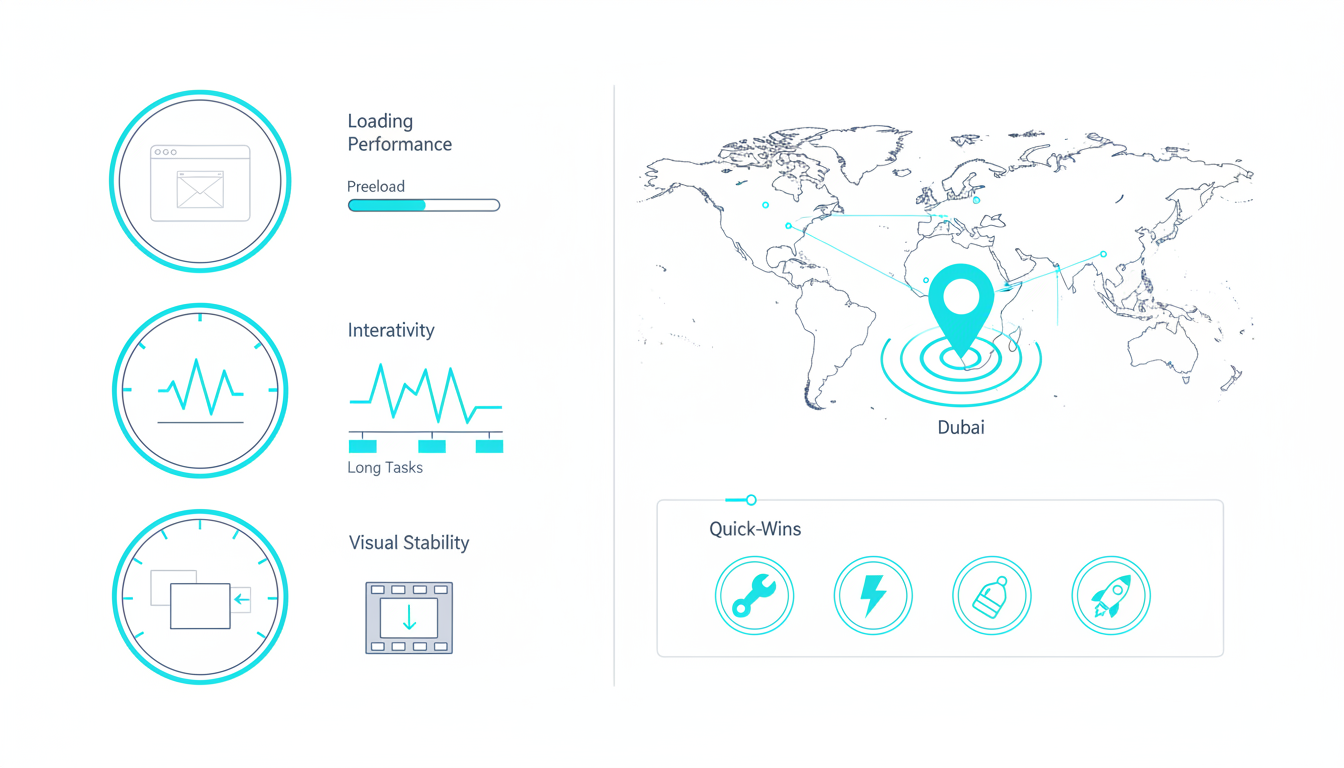
Page experience signals directly impact rankings. Core Web Vitals optimization addresses the three metrics Google uses to measure loading speed, interactivity, and visual stability.
Largest Contentful Paint (LCP) measures loading performance. Interaction to Next Paint (INP) tracks responsiveness. Cumulative Layout Shift (CLS) quantifies visual stability. Each metric requires different optimization approaches.
LCP Optimization Priority Path
LCP measures how quickly your main content loads. Target: under 2.5 seconds for 75% of page visits. Slow LCP frustrates users and signals poor experience to search engines.
- Optimize server response time through caching and CDN configuration
- Eliminate render-blocking resources in critical path
- Preload key resources like hero images or fonts
- Compress and optimize images without quality loss
- Implement lazy loading for below-fold content
For Dubai-based sites, CDN selection matters. Local hosting or regional CDN nodes reduce latency for GCC traffic while maintaining global performance.
INP Improvements for Better Interactivity
INP replaced First Input Delay as the interactivity metric. It measures responsiveness across all user interactions, not just the first click. Target: under 200 milliseconds for smooth experiences.
Heavy JavaScript execution blocks the main thread and delays responses to user actions. Breaking up long tasks and optimizing event handlers improves INP scores significantly.
- Identify long tasks blocking main thread (over 50ms)
- Break monolithic scripts into smaller chunks
- Defer non-critical JavaScript execution
- Optimize event handler efficiency
- Reduce third-party script impact on interactivity
Bilingual SEO Architecture for Dubai Markets
Arabic and English content requires careful technical implementation. Poor hreflang setup sends users to wrong language versions and splits ranking signals between duplicate content.
Your international SEO audit validates language targeting, URL structure, and content parity between versions. Proper implementation ensures each language version ranks in appropriate markets.
Hreflang Validation and Language Mapping
Hreflang tags tell search engines which language version to show users based on location and language preferences. Implementation errors cause ranking dilution and user experience problems.
- Validate hreflang tag syntax and reciprocal linking between language versions
- Confirm URL structure consistency (subdirectories vs subdomains)
- Check x-default tag implementation for unmatched regions
- Verify language declarations in HTML lang attributes
- Test regional targeting in Google Search Console
Common mistakes include missing return links, incorrect language codes, and conflicting signals between hreflang tags and content language. Each error confuses search engines and weakens rankings.
Content Parity and Cultural Adaptation
Machine translation creates thin content that performs poorly. Professional translation with cultural adaptation ranks better and converts higher.
Content audits compare Arabic and English versions for depth, keyword optimization, and user intent alignment. Gaps in coverage or quality signal which pages need improvement.
- Assess translation quality and cultural appropriateness
- Identify content gaps between language versions
- Optimize Arabic keyword targeting for regional search behavior
- Validate metadata translation and length constraints
- Review internal linking structure within each language tree
CMS-Specific Technical Considerations
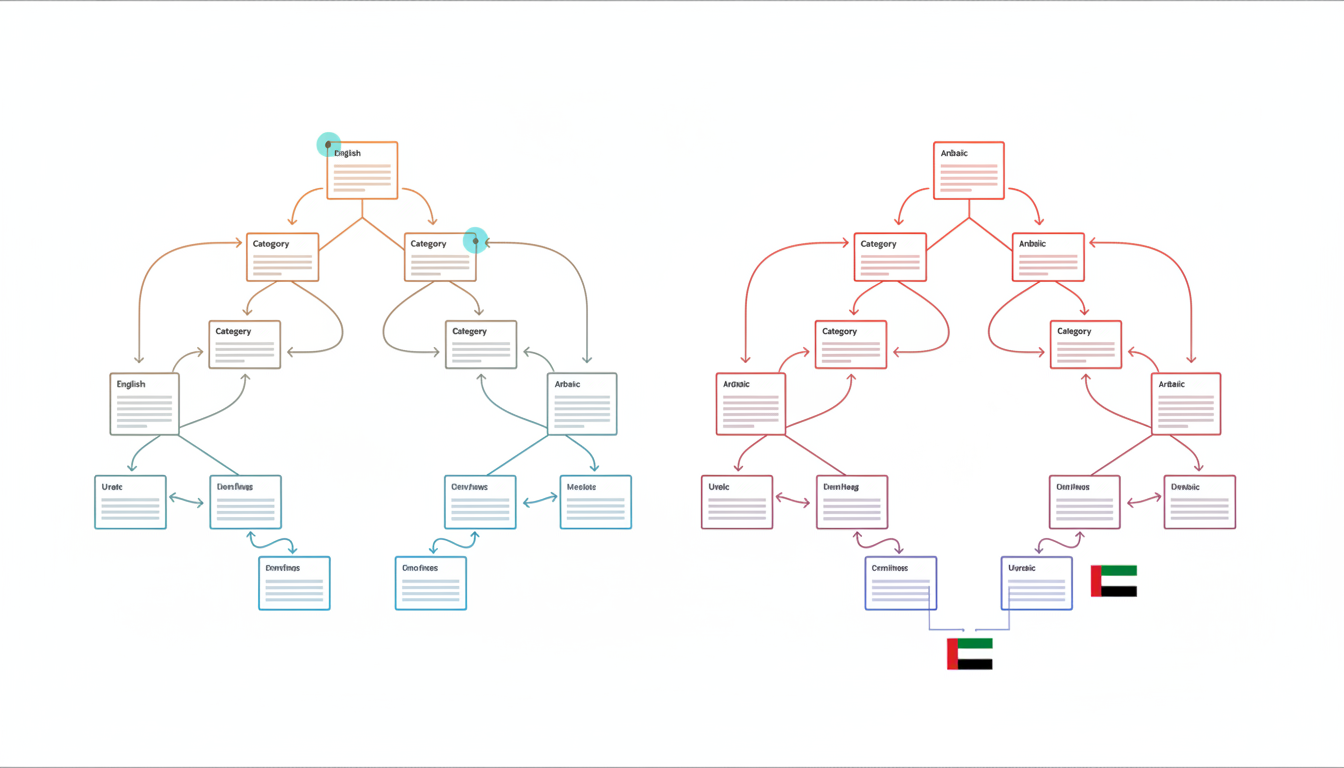
Different content management systems create distinct technical SEO challenges. Your CMS SEO audit addresses platform-specific issues that generic recommendations miss.
WordPress, Shopify, and headless CMS architectures each require tailored approaches to URL structure, rendering, and performance optimization.
WordPress Technical Audit Focus Areas
WordPress powers millions of sites with varying quality. Plugin conflicts, theme bloat, and database inefficiencies create performance and crawlability issues.
- Plugin audit for performance impact and conflicts
- Database optimization for faster query execution
- Image optimization and lazy loading configuration
- Caching strategy implementation and validation
- Security hardening to prevent SEO spam injection
WordPress sites often accumulate technical debt through plugin proliferation. Consolidating functionality and removing unused plugins improves performance significantly.
Shopify SEO Audit Priorities
Shopify’s closed architecture limits customization but creates predictable optimization paths. Shopify SEO services audit work focuses on template optimization, app selection, and product page structure.
Watch this video about affordable seo audit services dubai:
- Theme code optimization for Core Web Vitals
- App audit to remove performance-degrading tools
- Product page template optimization for conversions
- Collection page structure and internal linking
- Structured data implementation for rich results
Shopify’s automatic sitemap generation and canonical tag handling work well for most stores. Custom requirements need theme-level modifications or app integrations.
Implementation Coordination with Development Teams
The gap between audit delivery and implementation kills most optimization efforts. Direct developer coordination ensures fixes ship correctly and quickly.
Your audit provider should speak your development team’s language. Technical specifications in Jira or Azure DevOps, clear acceptance criteria, and sprint-ready formatting accelerate deployment.
Ticket Template for Implementation Success
Each audit finding becomes an executable ticket with context, specifications, and validation criteria. This template eliminates ambiguity and speeds estimation.
Title: Optimize LCP by preloading hero image Priority: High Sprint: 1 Effort: 2 points Problem: Hero image loads after 3.2s, causing LCP failure on 68% of mobile visits. Solution: Add preload link tag for hero image in document head. Implementation: <link rel="preload" as="image" href="/images/hero.webp"> Acceptance Criteria: - LCP under 2.5s for 75% of mobile visits - No layout shift from image load - Validated in PageSpeed Insights Dependencies: None Rollback: Remove preload tag if other resources delayed
This format gives developers everything needed to implement, test, and validate the fix without additional research or clarification meetings.
Sprint Sequencing for Maximum Impact
Not all fixes carry equal weight. Strategic sequencing delivers quick wins while building toward complex optimizations.
Sprint 1 tackles critical issues blocking crawlers or causing severe user experience problems. These fixes often take minimal effort but produce immediate results.
- Fix broken internal links and 404 errors
- Resolve duplicate content through canonicalization
- Correct robots.txt blocks on important pages
- Implement missing meta robots directives
- Add structured data for rich results
Sprint 2 addresses Core Web Vitals and mobile usability. These improvements affect user experience and ranking signals simultaneously.
Later sprints handle information architecture refinements, content optimization, and advanced technical enhancements that require more planning and coordination.
Post-Audit Monitoring and Measurement
Implementation without measurement wastes effort. Daily monitoring proves ROI and catches issues before they compound.
Your SEO implementation roadmap includes specific KPIs, measurement tools, and reporting cadence. Track technical health, ranking movements, and traffic patterns to validate improvements.
30-60-90 Day Measurement Plan
Different metrics matter at different stages. Short-term indicators validate implementation quality. Long-term metrics prove business impact.
Days 1-30: Technical health indicators
- Crawl error reduction in Search Console
- Core Web Vitals improvement across device types
- Mobile usability issue resolution
- Indexation rate for new or updated pages
- Site speed improvements in lab and field data
Days 31-60: Early ranking signals
- Ranking improvements for target keywords
- Impressions growth in Search Console
- Click-through rate changes for key pages
- Featured snippet captures
- Rich result appearances in SERPs
Days 61-90: Business impact metrics
- Organic traffic growth to optimized pages
- Conversion rate improvements from organic traffic
- Revenue attribution to SEO improvements
- User engagement metrics (bounce rate, time on site)
- Return on investment calculation
Migration Audit Playbook for Platform Changes
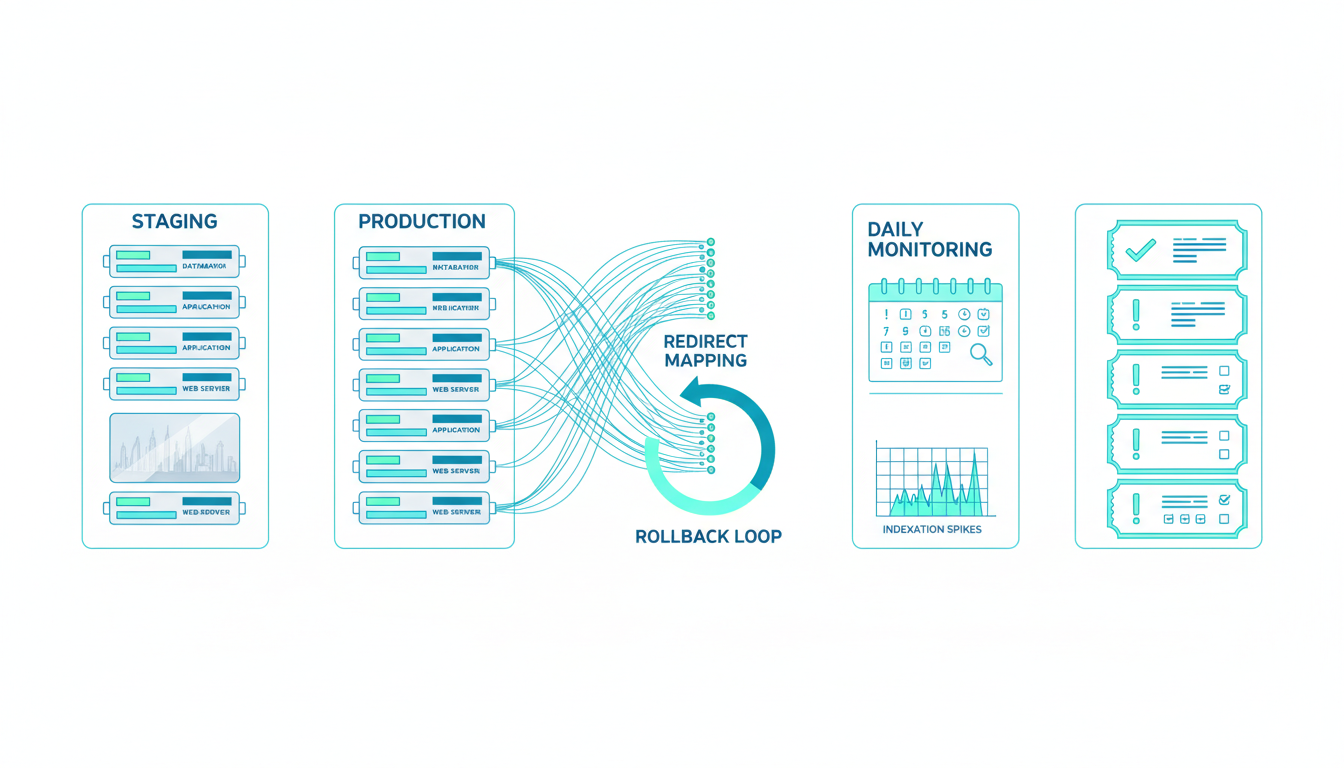
Website migrations carry significant SEO risk. Poor execution causes permanent traffic losses that take months or years to recover.
Pre-launch validation catches issues before they go live. Post-migration monitoring identifies problems quickly so your team can fix them before rankings suffer.
Pre-Migration Technical Validation
Test everything in staging before launch. Catching issues pre-launch costs hours. Fixing them post-launch costs traffic and revenue.
- Crawl staging site to identify broken links and redirect chains
- Validate URL mapping between old and new structures
- Test redirect implementation (301 status codes, no redirect chains)
- Verify canonical tags point to correct URLs
- Confirm hreflang tags if international site
- Check robots.txt and meta robots directives
- Validate structured data implementation
- Test Core Web Vitals on new platform
Document every URL change in a migration map. This spreadsheet becomes your validation tool and rollback reference if issues occur.
Post-Launch Daily Monitoring Protocol
The first 30 days after migration determine success or failure. Daily monitoring catches issues while they’re still fixable.
- Monitor Search Console for crawl errors and indexation drops
- Track ranking positions for key terms daily
- Watch organic traffic patterns for unexpected drops
- Validate redirect chains aren’t forming
- Check that old URLs properly redirect to new ones
- Monitor Core Web Vitals for performance regressions
Set up automated alerts for significant changes. Traffic drops over 20%, ranking losses for priority terms, or crawl error spikes require immediate investigation.
Choosing the Right Audit Provider in Dubai
Provider selection determines audit value more than price. The cheapest option often costs most when implementation fails or findings prove unusable.
Evaluate providers on implementation support, technical depth, and post-delivery coordination rather than page count or turnaround time.
Critical Evaluation Criteria
Ask specific questions about methodology, deliverables, and support. Vague answers signal generic approaches that won’t address your specific challenges.
- What tools do you use? – Proprietary tools signal technical sophistication and deeper analysis
- How do you prioritize findings? – Look for impact/effort matrices and sprint-ready sequencing
- What format are deliverables? – Jira-ready tickets beat PDF reports every time
- Do you coordinate with dev teams? – Direct developer access accelerates implementation
- What post-delivery support is included? – Ongoing monitoring proves commitment to results
Request sample deliverables from past audits. Review ticket format, specification detail, and implementation guidance quality.
Red Flags That Signal Poor Value
Some warning signs indicate providers who deliver reports rather than results. Avoid these patterns when evaluating options.
- Emphasis on page count or report length over implementation support
- Generic recommendations without site-specific context
- No mention of developer coordination or sprint planning
- Unwillingness to share methodology or sample deliverables
- No post-delivery support or monitoring included
- Vague pricing without clear scope boundaries
- No technical certifications or tool partnerships
Frequently Asked Questions
How long does a technical SEO audit take?
Timeline depends on site complexity and audit scope. Small business sites (under 500 pages, single language) take 5-7 days. Mid-market sites with bilingual content need 10-14 days. Enterprise sites with JavaScript frameworks and complex architectures require 3-4 weeks for thorough analysis.
What’s included in an implementation-ready audit?
Implementation-ready audits deliver Jira tickets with specifications, acceptance criteria, and effort estimates. You get prioritized roadmaps organized by sprint, direct developer coordination during deployment, and post-implementation monitoring to validate fixes work correctly.
How much does a quality audit cost in Dubai?
Small business audits range from AED 7,500-15,000. Mid-market sites cost AED 15,000-35,000. Enterprise audits run AED 35,000-75,000. Migration or recovery audits typically cost AED 25,000-60,000. Price reflects site complexity, languages supported, and implementation support level.
Do I need separate audits for Arabic and English content?
No. Quality bilingual audits analyze both language versions simultaneously, validating hreflang implementation, content parity, and language-specific optimization. Separate audits waste money and miss cross-language issues that affect rankings.
How quickly will I see results after implementing fixes?
Technical health indicators improve within 1-2 weeks. Ranking improvements typically appear within 30-60 days. Traffic and revenue impact becomes measurable at 60-90 days. Timeline varies based on issue severity, implementation quality, and competitive landscape.
What happens if traffic drops after implementing changes?
Quality providers include rollback procedures in every ticket. If changes cause issues, your team can reverse them immediately. Post-implementation monitoring catches problems within 24-48 hours, limiting damage and enabling quick corrections.
Can you audit Shopify or WordPress sites?
Yes. Platform-specific audits address CMS limitations and optimization opportunities. WordPress audits focus on plugin efficiency, theme optimization, and database performance. Shopify audits tackle theme code, app selection, and template structure within platform constraints.
How do you handle JavaScript-heavy sites?
JavaScript audits use specialized crawling tools that execute JavaScript like search engines do. Analysis compares server-side and client-side rendering, identifies JavaScript errors blocking indexation, and provides optimization paths for Core Web Vitals improvements.
Moving from Diagnosis to Deployed Fixes
Affordable SEO audits deliver implementation speed, not just documentation. The right provider gives you sprint-ready specifications, developer coordination, and monitoring that proves ROI.
Pricing scales with site complexity – JavaScript frameworks, multilingual content, and large catalogs require deeper analysis. But investment pays back through faster fixes and measurable traffic recovery.
- Implementation-first audits cut time-to-fix by 60-70% compared to generic reports
- Jira-ready tickets eliminate interpretation delays and clarification meetings
- Direct developer coordination ensures fixes ship correctly the first time
- Post-audit monitoring validates improvements and catches issues early
- Clear pricing bands help you budget accurately and compare providers fairly
Your next step depends on current challenges. Traffic declines need recovery audits. Platform migrations require pre-launch validation. Growing sites benefit from architectural analysis before problems compound.
Explore our three-phase methodology to see how we structure sprint-ready specifications and coordinate with development teams. Or request a technical audit to get a prioritized, implementation-ready roadmap for your specific situation.